Showing posts with label march for jobs. Show all posts

Struggle for jobs comes to G-20


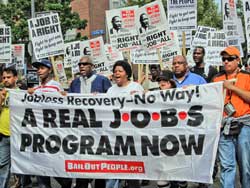
More than 1,000 protesters marched through the streets here on Sept. 20 demanding a real jobs program, like the public works program the Roosevelt administration enacted during the Great Depression of the 1930s.

It was the first demonstration related to the G-20 summit, a gathering of Treasury officials and central bankers from 20 countries that is to take place in the city later in the week. The goal of the G-20 is to protect bank profits. The goal of the March for Jobs is to revive Dr. Martin Luther King Jr.’s call for the right of all to a job. The march was organized by the Bail Out the People Movement and the Rev. Thomas E. Smith, pastor of the Monumental Baptist Church, and endorsed by the United Steelworkers union and the United Electrical Workers.


slideshow photos by LeiLani Dowell, Brenda Sandburg, Dante Strobino and G. Dunkel

The march garnered coverage and interest from major big-business media, both nationally and locally, including the Associated Press, Reuters, the Wall Street Journal, the French Press Agency and others. Organizers of the march attributed the media interest to the fact that the march addressed the crisis of joblessness and its devastating impact on the Black community.

People came from cities throughout the country to join a significant number of Pittsburgh area residents for the march. The cities represented included Los Angeles, San Francisco, Detroit, Cleveland, Akron, Minneapolis, Baltimore, Miami, New York, Buffalo, Philadelphia, Providence, the North Carolina Triangle area and Boston. Many have been laid off or lost their homes to foreclosures. Despite the crisis, people were spirited, drawing strength from being together and from building a movement.

“In honor of Martin Luther King we are continuing what he started in uniting people together in a poor people’s campaign,” the Rev. Tom Smith, pastor of Monumental Baptist Church and one of the organizers of the march, told the rally. “The G-20 is structuring deals to protect the corporations and not the workers. It’s time for the workers to come together and make a difference.”

People gathered in the morning at Monumental Baptist Church located in the historic African-American Hill district of Pittsburgh. A tent city dedicated to the unemployed had been set up next to the church the day before. Many of the protesters will stay at the tent city throughout the week with more people expected to join as the G-20 summit opens.

An opening rally was held before the march stepped off at about 2:30. People marched carrying hundreds of placards with the image of Dr. Martin Luther King Jr. and chanting, “We got the right! We got the right to a job!” The march ended at Freedom Corner, where in 1963 people got on buses to go to the historic civil rights march in Washington, D.C.

Larry Holmes, an organizer of the Bail Out the People Movement, said the government claims a jobless recovery is on the horizon. He emphasized that this is unacceptable. “A jobless recovery is like a dead patient after a successful operation,” he said.

Monica Moorehead of the organization Millions for Mumia recognized the more than two million people in prison who couldn’t be at the demonstration. She introduced a taped message from political prisoner Mumia Abu-Jamal.

At the closing rally, Fred Redmond, United Steelworkers vice president, noted the need for universal health care and affordable education as well as jobs for all. “Enough of our kids are going to school where the rats outnumber the computers,” he said. “We have to assure that every child receives an education to equip them for the 21st century.”

Other speakers at the two rallies included Oscar Hernandez, a participant in the 11-month Stella D’Oro bakery strike in New York City; Clarence Thomas, International Longshore and Warehouse Union Local 10 and Million Worker March Movement; Brenda Stokely and Jennifer Jones, NYC Coalition in Solidarity with Katrina/Rita Survivors; Rob Robinson, Picture the Homeless; Rosemary Williams, Poor Peoples Economic Human Rights Campaign; Mick Kelly, Coalition for a Peoples Bailout; Nellie Bailey, Harlem Tenants Council; John Parker, Bail Out the People Movement organizer in Los Angeles; Sandra Hines, Michigan Moratorium NOW! Coalition to Stop Foreclosures, Evictions and Utility Shutoffs; Rokhee Devastali, Feminist Students United, University of North Carolina-Chapel Hill; civil rights attorney Lynne Stewart; Larry Hales, FIST (Fight Imperialism Stand Together); Larry Adams, People’s Organization for Progress; Pam Africa, International Concerned Family and Friends of Mumia Abu-Jamal; Victor Toro, an immigrant facing deportation and member of the May 1st Coalition for Worker & Immigrant Rights; Berna Ellorin, BAYAN-USA; Father Luis Barrios, Pastors for Peace; Kali Akuno, U.S. Human Rights Network; and Pennsylvania state Sen. Jim Ferlo.

Why people came to Pittsburgh

The march was a powerful draw for people, many of whom traveled long distances to be part of the event. Strikers from TRW Automotive, a seatbelt-making plant in Mexico, had been in Detroit speaking out about their struggle when they heard about the protest in Pittsburgh and joined the bus from Detroit. One member of the TRW group, Israel Mouroig of the Coalition for Justice in the Maquiladoras, said it was necessary to forge alliances at the international level. “Corporations that generate billions of dollars a year produced the crisis in our country,” he said. “There is a lack of jobs because they see the working class as robots, as numbers. We have to appropriate the means of production and be the actors of our own history.”

Several people drove from Los Angeles, including Guy Anthony, who lost his job as an organizer with the Service Employees union in June. Now living in his car, he has traveled around the country writing a blog about his experiences (thedistantdrummer.com). “You can’t talk about joblessness without talking about homelessness,” Anthony said. He met people in Seattle who had set up “a fabulous tent city” on church property. He also stayed with people who set up a homeless community at a roadside stop off of Route 280 south of San Francisco. “You couldn’t want better neighbors,” he said. “Nobody went hungry. It was a beautiful socialist community.” The county recently shut the group down.

A large contingent from the Boston School Bus Drivers union, USW Local 8751, including Gary Murchison, former three-term president of the local, and Frantz Mendes, current president, showed up three days before the march to help organize and build the tent city.

Detroit activists, who organized a hugely successful tent city in June, brought a busload of people to Pittsburgh. “We had to be here,” said Sandra Hines of the Moratorium NOW! Coalition. “We have to mobilize, organize before they take every right we have away from us.” Latonya Lloyd, who was part of the Detroit delegation, recently battled the shut-off of utilities at the Highland Towers apartment building.

Mary Kay Harris came with about 40 other people on a bus from Rhode Island. A member of DARE (Direct Action for Rights and Equality), Harris said that as soon as they heard about the March for Jobs they decided they had to be there. Rhode Island, which has one of the highest unemployment rates in the country, has a tent city of the homeless. “We feel that solidarity is the most important thing,” she said.

Activists in Cleveland also brought a busload of people, including a large contingent from the Poor People’s Economic Human Rights Campaign. And a group of 18 youth came from North Carolina, including Tracy Gill, a member of FIST who said this was the first big protest she had ever been to.

Members of the Minnesota People’s Bailout Coalition also came to the march. Angel Buechner said the organization had fought for legislation last year that would have provided immediate jobs or income and a moratorium on foreclosures and on the state’s five-year limit on receiving welfare. But Gov. Tim Pawlenty defeated the measure. Despite the setback, Buechner is ready to continue the battle.

At the ending rally at Freedom Corner, Holmes announced—to the approval of the crowd—that the next step is to build a national march for jobs in Washington next April to continue Dr. King’s dream.


A tale of two cities in Pittsburgh


Sept. 16—As the G-20 Summit prepares to descend upon Pittsburgh, the city has been thrust into the spotlight, and is being highlighted for its “commitment to employing new and green technology to further economic recovery and development.” It has been and is being denoted as the city that got it right, where pollution has been eroded, the rivers cleaned, and the jobs in industry have thoroughly been replaced.

But this is farce. The changes are superficial and the most oppressed workers have not recovered from the loss of steel jobs; this fact is most clearly seen in neighborhoods like the Hill District.

While the dignitaries that represent the G-20 countries are shown a “revitalized” downtown Pittsburgh, they will not see the conditions of neighborhoods that surround downtown.

As far as gatherings go, the starkest contrast in Pittsburgh during the G-20 Summit week will be between the glamour and glitz of the summit, the primped and polished downtown hotels where world leaders and finance ministers will stay, on the one hand, and, on the other, the Hill—about a mile away from the G-20 Summit convention—where those protesting unemployment will be sleeping in a tent city.

Following a march for jobs on Sept. 20, protesters will live on the Hill throughout the week until the end of the G-20 Summit. The Hill is one of the oldest, poorest, most renowned and besieged African-American neighborhoods in the country.

Once known for its nightlife and jazz clubs, today the streets of the Hill—where famed playwright August Wilson was born—have more than a few boarded houses and failed restaurants, small businesses and neighborhood stores. Parts of the Hill look more like the poorest neighborhoods in Port-au-Prince or the Gaza Strip than a U.S. city.

Most young people of working age who live on the Hill are not only unemployed, most have never had a job, and there are fewer and fewer low wage jobs available to them. From as far back as the mid-1950s, real estate interests have been working hard to push the native poor and working-class inhabitants out of the Hill to make way for the more well-to-do. While that process is not over, the rich, right now, are winning the war for control of the Hill.

I was not born in Pittsburgh, but in another part of western Pennsylvania—Erie, Pa.—where the conditions are different but similar. I was born in 1976 and spent my first 15 years there. My parents worked in factories, my mother making ceramics and my father still for GE Transportations, where he is anticipating retiring after 40 long years making locomotives and locomotive parts.

Both of my parents migrated to Erie from southern Mississippi. They were in their late teens, and neither had a high school education. During the period when my parents migrated from the South, there were many thousands more Black people who did the same, fleeing the repressive and racist conditions in the South in hopes of better paying jobs and better social relations.

By the time I became cognitively aware, conditions in western Pennsylvania and eastern Ohio had already begun to change. The well-paying jobs in the factories were beginning to dry up, and working people in what has now become known as the Rust Belt were being cast off from their jobs in the tens of thousands as deindustrialization set in, sweeping the land like a foreboding cloud of doom.

I can recall the looks on the faces of children I attended school with. Their parents would lose their jobs, and though as children we could not completely comprehend the consequences of our parents’ unemployment, the despair on their faces was enough. It’s like a child who falls but looks around for the reaction of the adults before deciding whether to laugh or cry.

I was not aware then—few of the children of factories workers really were—of what was happening in Pittsburgh, the shuttering of steel plants because of technology or outsourcing. Pittsburgh is much larger than Erie, and has a richer history of struggle, but is also a city that had long been under the sway of the Mellons, Carnegies and other super-rich who made their fortunes off of the exploitation of working people, even hiring armed thugs like the Pinkertons to shoot down striking workers.

Pittsburgh, like Erie and most U.S. Midwest cities where 20 percent of the population is Black, is largely segregated. But at least Black people had the Hill. Back in the day, the Hill was the place that Black steelworkers could make a better life for their families than their parents could make for them. The hope of those on the Hill who are trying to hold on to all they have is that the jobs march and tent city will help them even the odds a little against the gentry.

People from as far away as North Carolina, New York, Miami, Detroit, Minneapolis and even California will be meeting on the Hill in front of Monumental Baptist Church at Wylie and Soho Streets at 2 p.m., Sunday, Sept. 20, for the march for jobs. The marchers, who are expected to be in the thousands, will march to Freedom Corner at Crawford and Centre Streets where there is a monument to civil rights activists and leaders.

After Black residents were pushed out of what was once called the lower Hill to make way for the development of a stadium, Freedom Corner is where the Black community rose up and proclaimed that the developers would not be able to push beyond that point. Freedom Corner is where thousands gathered in the summer of 1963 to board buses to travel to the historic civil rights march in Washington, D.C. It is also where angry and shocked people gathered on that terrible day in April 1968 when Martin Luther King Jr. was assassinated.

There could not be a more appropriate location in Pittsburgh for the jobs march to rally because it was Dr. King’s vision of a second civil rights movement, a movement for the right of all to decent paying jobs, that the civil rights leader dedicated the final weeks of his life to. The goal of the jobs march is to revive that vision. After the rally, many will return to Monumental Baptist Church, the site of the Bail Out the Unemployed Tent City, to get ready for their first night underneath the sky.

Hales is a native of Erie, Pa., a leader of FIST (Fight Imperialism, Stand Together), and a regular contributor to Workers World. Posted just before the G-20 demonstrations, Hales’ commentary can be found on Real Talk Xpress, the International Action Center, fistyouth.wordpress.com and other sites and blogs.

Photos from Today's March for Jobs in Pittsburgh


All photos: LeiLani Dowell

AS UNEMPLOYMENT RISES: Momentum grows for national jobs march in Pittsburgh

“We’ve seen 20 consecutive months of job losses,” said Larry Holmes, a national organizer with the Bail Out the People Movement. “That’s more than any other time since the last Great Depression, and the official number doesn’t count those who are underemployed, incarcerated, or who have just given up looking for work.

With the Sept. 4 announcement that unemployment in the U.S. has hit an official high of 9.7 percent, organizing for the National March for Jobs on Sept. 20 in Pittsburgh and the Tent City in Solidarity with the Unemployed has reached a critical stage. Unemployed workers and their allies will be in Pittsburgh at the same time the G-20 Group of major capitalist countries will be holding their summit in that city.

“The unemployed, the homeless, the hungry and the poor must no longer be invisible and silent. On Sunday, Sept. 20, a National March for Jobs will step off from the historic Hill District in Pittsburgh just prior to the G-20 summit demand a real jobs program. Community activists from across the country are organizing buses, vans and caravans to come to Pittsburgh,” said Holmes.

Below is a sampling of some of the organizing being done around the U.S. to bring poor and working people, including the unemployed, to Pittsburgh for the jobs march and tent city.

California

California activists are busy organizing a bus to Pittsburgh for the Sept. 20 jobs march and tent city.

“Why am I organizing a bus to Pittsburgh? Because we have no choice. It’s a matter of survival,” said one of the many activists building California’s participation in the jobs march at the G-20 Summit. Because California is now reeling from the fourth largest unemployment rate in the country while legislators continue to cut basic services, this enthusiasm and determination is widespread.

In San Francisco, a resolution supporting the demonstration was unanimously passed by the San Francisco Labor Council, as well as by the S.F. Letter Carrier’s union Local 214 and Local 10 of the International Longshore and Warehouse union.

Dave Welsh, a retired letter carrier and organizer for the jobs march, spoke about the sentiments of autoworkers in the northern California town of Fremont. He was at a protest outside a Toyota plant threatened with closure. “We went there with leaflets about the jobs march. There were about 1,000 people out there and this seemed to be the only leaflet being passed out. It got a very good response. People would look and point to it and say, ‘Right on!’’’ said Welsh.

In Los Angeles organizers are receiving calls from Riverside to San Diego asking about the bus to Pittsburgh. John Parker, an organizer with the Bail Out the People Movement, stated: “Although providing transportation to go across the country, especially for unemployed workers, is an expensive venture, we must make it happen. We want to have a delegation of participants who travel great lengths and make stops along the way to highlight California’s growing jobless and homeless plight.

“This is very important since the worsening trend in California’s economy has become a crystal ball showing the bleak future for working people in the entire country and an example of how politicians refuse to address the needs of working and poor people and instead cater to the needs of the superrich monopoly banks and corporations.”

For information about the bus from California to Pittsburgh call 323-306-6240.

Ohio

Activists in the Ohio cities of Cleveland, Akron, Warren and Youngstown are organizing to send a strong delegation to the Sept. 20 March for Jobs. Geographically they are less than a three-hour drive away. Economically they have seen the same devastation wrought by almost three decades of restructuring in steel, auto, rubber and other manufacturing industries. In all of these cities a disproportionate share of the hardship is being borne by the African-American community and all communities of color.

Recently a number of key activists came to meetings organized by the Cleveland Bail Out the People Movement chapter that featured Sharon Black, the national labor outreach coordinator for the jobs march. Attending the meetings were representatives of the New Black Panther Party, the American Friends Service Committee, Cleveland FIST (Fight Imperialism, Stand Together) and the Family Connection Center, which advocates for women receiving or losing public assistance. Joining these student and community organizers were members of the Teamsters, the United Auto Workers, the Amalgamated Transit union and the American Federation of Government Employees.

The meetings generated tremendous excitement for the march—excitement that proved contagious when Cleveland BOPM distributed leaflets at the annual Labor Day parade sponsored by the AFL-CIO. Contingents of airline workers indicated that they were already aware of the march and members of the United Steelworkers said they had started organizing transportation from Cleveland to Pittsburgh. A Cleveland high school marching band expressed interest in being part of the march.

Detroit

Organizers with the Moratorium NOW! Coalition to Stop Foreclosures, Evictions and Utility Shutoffs have been in the streets and neighborhoods getting out the word about the Sept. 20 jobs march. Activists distributed thousands of leaflets at the African World Festival in downtown Detroit, at citywide protests against cuts in bus services, and at the annual Labor Day parade. Organizers report that interest was high at the Labor Day event, with many unionists expressing interest and enthusiasm. Detroit FIST activists have also been doing outreach to youth and students.

New England

Organizing is going strong in the greater Boston area and in Massachusetts in general and Rhode Island. Buses to the Sept. 20 jobs march in Pittsburgh are being organized from Boston, western Massachusetts and Rhode Island. A strong labor/community coalition is being built. Steelworkers Local 8751, the Boston School Bus Drivers union, is a member of the coalition and is subsidizing bus seats for members.

Members of the No Layoffs Campaign at Harvard University, including members of UNITE-HERE Local 26 and the Harvard Union of Clerical and Technical Workers, are participating and organizing. Community organizers from local neighborhood health centers and youth programs are also taking part. The Women’s Fightback Network and Boston FIST are playing a strong role.

Atlanta

A convergence of events has led to a decision to set up a tent city in solidarity with Pittsburgh on Sept. 20 on the grounds of the city hall complex in Atlanta. The Task Force for the Homeless, which has been under an escalating siege by the city administration and major downtown developers and corporations, is bringing a lawsuit against certain officials and business groups, charging them with “tortuous interference” in the financial support for their homeless shelter. Loss of funds has caused the Task Force to have its water cut off and to be on the brink of bankruptcy.

As a result of this lawsuit, they have gotten lots of documentation of collaboration between members of the mayor’s staff and Chamber of Commerce-types about planting false stories in the press, having direct contact with funders to strongly suggest they sever ties with the Task Force, etc. The lawsuit will reveal the behind-the-scenes operations of the power structure that controls Atlanta. The opening day of the lawsuit is Sept. 21.

The Task Force is initiating a tent city to be set up at noon on Sept. 20 in solidarity with the jobs march and tent city in Pittsburgh. It will include an evening cultural event and rally and a march from the tent city to the courthouse the next day for the hearing.

New York-New Jersey

The Peoples Organization for Progress recently hosted a delegation in Newark, N.J., from the Bail Out the People Movement that included Brenda Stokely and Sara Flounders. Names were gathered of POP members that plan to go to Pittsburgh.

The enthusiasm in Newark reflects the growing interest in the region. Because of this, another bus has been ordered. New York groups building for Pittsburgh or new endorsers include Picture the Homeless, the Rebel Diaz hip-hop group, Katrina/Rita survivors, the May 1st Coalition for Worker and Immigrant Workers and the Iglesia San Romero in the Washington Heights area.

A leader of the Stella D’Oro strike in the Bronx, Mike Filippou, also became a convener of the jobs march and agreed to provide a speaker. Stella D’Oro workers went out on strike in August 2008 and stayed on strike until July 7, when the National Labor Relations Board voted favorably. Now the owners of Stella D’Oro, Brynwood Partners, are threatening to close the plant and move it elsewhere.

Organizers of the Pittsburgh march for jobs hope to elevate the Stella D’Oro struggle to a national level by inviting the workers to participate at events around the G-20.

Dozens of BOPM volunteers blitzed Caribbean Day in Brooklyn to get the word out for Sept. 20. Paste-ups and other visibility activities are going strong. Organizers from BOPM joined the Stella D’Oro contingent on Labor Day in New York City on Sept. 12, when thousands of leaflets were distributed.


www.bailoutpeople.org

G-20 or more G-money

MUMIA ABU-JAMAL FROM DEATH ROW
Mumia Abu-Jamal

Mumia Abu-Jamal

From an Aug. 18 audio column which will be played at the Sept. 20 jobs march and rally for the unemployed in Pittsburgh.

As the G-20 gathers again, they assemble amidst the wreckage of their own creation.

Representatives of 20 of the alleged developed economies, they are instead representatives of casino capitalism: the use, misuse and grand theft of public wealth to fund the bonuses of financial pirates that have looted the treasury of billions.

A few months ago, as they gathered in London, the nations’ finance ministers talked about tax havens, but few had any real substantial solutions to the economic turmoil roiling in their own countries.

Much has been said about stimulus packages, and even about the enormous amounts of money being allocated for this purpose, but a modest amount has actually been spent, with the lion’s share being devoted to boosting the very banks and businesses that created this disaster.

And while banks and billionaires have been rewarded for their insatiable greed, average people, working people, families struggling in the worst economic environment since the 1930s, are on their own. Millions are jobless. Many are homeless. Many more are helpless.

And while they barely survive day after day, big buck bonuses are back on track at Goldman Sachs and other such entitles in the City.

Politicians, meanwhile, talk of a “jobless recovery.” If there are no jobs, who can really speak of a recovery? Wall Street is recovering—but are you?

Even the French conservative president, Nicolas Sarkozy, said the economic disaster of last fall spelled the end to laissez-faire (French for ‘let it be’) economic theory. Governments on both sides of the Atlantic are giving various stimulus packages to banks and businesses that look an awful lot like life support.

If this is free market, then slavery was free labor. Only a bold, unified people’s movement can put the people’s interests before that of big finance. It’s going to take protests—real protests—to break through this vampire’s bite on the wealth of nations.

For Immediate Release:

The first and largest PITTSBURGH G-20 Related protest
March for Jobs in Pittsburgh
Sunday, September 20
to be followed by week-long “Bail Out the Unemployed” Tent City

Thousands of protesters will be arriving in Pittsburgh next weekend to participate in the first and largest protest related to the G-20 summit. The March for Jobs will step off at 2:30 p.m. on Sun., Sept. 20 after an opening rally in front of Monumental Baptist Church at 2228 Wylie St. in the historic African-American Hill district of Pittsburgh. The marchers, coming into the city from every region of the country including as far away as California, will hold an end rally at Freedom Corner at Centre St. and Crawford St. Freedom Corner is a monument to civil rights activists which borders Pittsburgh’s downtown area.

After the rally, many of the marchers will return to a field near Monumental Baptist Church where they will live in a tent city dedicated to the unemployed of the world for the entire week of the G-20 summit. The tent city, which will house unemployed people and their supporters from Sun., Sept. 20 through Fri., Sept. 25, at the “Bail Out The Unemployed “tent city. More details about the tent city below. Speakers at the Jobs march and rally include Fred Redmond, Vice Pres. of the United Steel Workers Union; antiwar activist Cindy Sheehan; Allegheny County Commissioner Bill Robinson; Prof. Cornel West; Rep. John Conyers; Penn. State Sen. Jim Ferlo and Rev. Thomas Smith amongst others.

The central goal of the march for jobs is to revive Martin Luther King Jr.’s call for a second civil rights movement for the right of all to a job.

Before the G-20 countries open their summit, the march for jobs and tent city seeks to dramatize the reality that the unemployment and under-employment level is not only reaching depression level statistics, but that the unusual and unprecedented nature of the current worldwide economic crisis may usher in a new and permanent high unemployment economy.

The jobs march will highlight the need for a massive jobs program on par with the public works program that the Roosevelt Administration enacted during the Great Depression of the 1930s.

The tentative schedule of the Bail Out the Unemployed Tent City is as follows:

BAIL OUT THE UNEMPLOYED - TENT CITY
dedicated to the unemployed of the world
Sept 20 – 25, Pittsburgh

Daily Teach-ins – discussion groups, programs, films, music, etc.:
(All times and programs subject to last minute change; lunch and dinner provided daily)

(Note: This work in progress does not include music yet – updated Wed., Sept. 9)

Sun., Sept. 20 – Early meeting @ 10 a.m. to 12/1p.m. (Orientation: “What after Pittsburgh” & breakfast)
Pre-march rally @ 2 p.m. – march 4 Jobs @ 2:30 p.m. – rally @ 3:30 p.m. - 4:30/5p.m.

Sunday Eve TBA

Mon., Sept. 21
GLOBAL SOLIDARITY: Unions, communities & movements working togetheR
(10 a.m. – 12 p.m.)
Organizing the global struggle for jobs & workers rights
Global Solidarity: What does it mean?
Immigrant workers rights & global solidarity
The biggest global economic crisis since the 1930s
What is the G-20?: The roots of the global crisis
(Groups: USW, BAYAN, May 1st Coalition for Worker and Immigrant Rights and others)

Students and Youth Meeting 12 p.m. - 2 p.m.

CONNECTING THE ISSUES: HOUSING IS A RIGHT
Healthcare, Education, War – 2 p.m. to 5 p.m.
A Moratorium on Foreclosure and Evictions
The Squatters Movement -The fight back is growing
We Remember Katrina (Groups: Picture the Homeless, Moratorium Now! Coalition Against Foreclosures and Evictions, Poor Peoples Human Rights Campaign, People’s Organization for Progress, NYC Coalition In Solidarity with Katrina/Rita Survivors)

Film on Mumia Abu-Jamal & Solidarity with Leonard Peltier 7 p.m. (Dinner)
(Group: Pittsburgh Mumia Coalition)

Tues., Sept. 22

(All events tentative unless noted otherwise)

Fulfilling King’s Dream: a Right to A job For All 10 a.m. –12 p.m.
The global joblessness crisis: how bad, how long?
What will it take start a jobs movement?
Needed: Jobs that pay a living wage
Needed: Jobs that help reconstruct society (Groups: Bail out the People Campaign, United Steel Workers, others)

Bring The Troops Home! Antiwar RALLY 2 p.m. – 5 p.m.
Money for jobs and education - not war and occupation
The war at home and abroad – connecting the issues
Fighting the Empire: Honduras, Palestine, Cuba, Iraq, Iran, Afghanistan (groups TBA)

STOP THE EXECUTION OF TROY DAVIS! 7 p.m.
(Pennsylvanians for Alternatives to the Death Penalty)

Wed., Sept. 23
the struggle for the right to Healthcare/ discussion group 10 a.m. – 12 p.m. (groups TBA)

PanEl Discussion On the G-20 3 p.m. – 6 p.m.
Leo Gerard, Int. Pres. United Steel Workers
Joseph Stiglitz, Nobel Laureate Economist
Emira Wood, Institute for Policy Studies
Berta Caceres, Coordinator, Consejo Civico de Organizaciones Populares e Indigenas de Honduras
Tammy Bang Liu, Labor/Community Strategy Center & Grassroots Global Justice Alliance
Carl Redwood Jr., Hill District consensus group
Rev. John Welsh, PIIN
(UE and Grassroots Global Justice alliance)


Rally for Clean Energy Jobs, Point State Park 6 p.m.

Thurs., Sept 24 (1st Day of G-20 summit)

Discussion groups and protests TBA

Fri.,Sept. 25 – Peoples March on G-20 – 12 p.m. (Tent city meeting other groups at Freedom Corner to march together)

Evening: Final tent city meetings and camp breakdown
The March 4 Jobs before the G20 Summit is Growing!

March for Jobs - September 20 - Pittsburgh

Breaking News Bulletin:

United Steel Workers Union and United Electrical Workers have endorsed and are mobilizing.

These are two powerhouse unions with a long and rich history
with international headquarters in Pittsburgh Pa.


Join USW – UE and many, many others on Sunday, Sept 20th, 2 p.m.

In front of Monumental Baptist Church, Soho Street & Wylie Avenue in Pittsburgh


If your community, union or student group is not already on board—there is still time to get involved.

  • Endorse – Organize – and Mobilize!
  • Distribute flyers and send out email notices.
  • Bring a bus, van or car from your city, town or neighborhood – tell us so we can plan parking.
  • Donate $ so that those without funds can attend.

VERY IMPORTANT: Please REGISTER for the Tent City.

If you are going to be participating at the ‘Solidarity with the Unemployed’ Tent City following the March 4 Jobs—it’s critical to register to make sure there are resources and space available. Space is limited. Pre-registration is required.

Register at http://www.bailoutpeople.org/septg20register.shtml


We need your help:

Donate

Why are we demanding jobs or income at the G-20 Economic Crisis Meeting in Pittsburgh in September?

30 million people in the U.S. are
unemployed or underemployed – We say NO!


What is the G-20?

It’s a group of Treasury officials and central bankers from 20 countries, the International Monetary Fund and the World Bank. Its goal is to protect bank profits, whatever it costs the people of the world.

The U.S. delegation is led by Treasury Secretary Timothy Geithner and Ben Bernanke, head of the Federal Reserve System (The Fed). They organized a bailout of the banks, insurance companies and stock brokerages that totals $12.6 trillion--or $42,105 for every adult and child in the U.S.

  • How much is a trillion dollars? It is 1,000 billion. And a billion is 1,000 million.

The Federal Reserve controls this money, yet most people have never heard of it. The Fed has seven governors, all bankers, appointed by the U.S. President for 14-year terms. George W. Bush appointed Bernanke Chairman of his Council of Economic Advisors and then head of the Fed. The Fed operates in secrecy, even from Congress, yet makes decisions affecting whether we work, have homes, or eat.

Geithner, the former chief of the NY Federal Reserve Bank, worked with the Fed under the Bush administration to devise the bank bailout. He invented the Troubled Assets Relief Program (TARP) and eight other programs to funnel taxpayer money into the banks. His top aide is from Goldman Sachs Bank. He changed bank regulations to prohibit congressional audits of the Federal Reserve.

Who is representing the people at the G20 conference? No one!

Profit recovery for banks –
Jobless ‘recovery’ for workers

The bailout for the banks:

  • $12.6 trillion in handouts, loans and guarantees.
  • Bonuses: Since the bailout, six banks that got our money are giving $74 billion in bonuses – double last year’s.
  • Even TARP chief Neel Kashkari says the bailout is “Rich bankers bailing out rich bankers, using the taxpayer’s credit card.”
  • The New York Times said the bailout of banks by taxpayers is a “Partnership in which one partner robs the other.”
  • Sen. Dick Durbin said, “We’re facing a banking crisis that many banks created – still they are the most powerful lobby on Capitol Hill, and they frankly own the place.”
  • Representative Alan Grayson, House Financial Services Committee, said of the Fed: “We are seeing a transfer of trillions of dollars of wealth from the taxpayers to the bad banks…. We have become the saps for Wall Street.”
  • Who got bailed out: Citigroup, AIG, Goldman Sachs, Lehman Brothers, Merrill Lynch, Bear Stearns, Morgan Stanley, Wells Fargo. Some have now merged into larger, more powerful monopolies.
  • Result: The banks are making huge profits again and concentration of wealth is in fewer hands. Instead of more regulation, they demanded and got less. The UN says just 500 rich people in the world earn more than the 416 million poorest people, and this is getting worse.
  • Instead of creating jobs they are demanding speedups. Corporate profits go up; wages go down and jobs or hours decrease.

Bailout money for us:

  • $8.2 billion

This is less than one-thousandth of the $12 trillion the banks have received.

Under the American Recovery and Reinvestment Act of 2009, most of this went to state unemployment insurance programs or job training programs—for JOBS THAT ARE NOT THERE. Just $25 a week went to those receiving unemployment insurance.

  • Result for us: 30 million people in the U.S. are unemployed or working involuntary part-time.

Wall Street admits unemployment will be permanently high. Unlike other times when workers were called back, millions of jobs have been terminated. Others have had their hours cut. There are fewer jobs now than in 2001, although 12 million new workers have joined the labor force.

  • Fewest young men have jobs in 61 years of record keeping.
  • Teenagers age 16-19 suffer 78% unemployment.
  • For youth and people of color, this is worse than the Great Depression.
  • Foreclosures are continuing at record levels this year.
  • People are running out of unemployment benefits.
  • Personal bankruptcies are up again.
  • Retirees have lost 22% of their benefits, forcing seniors to work--but there are no jobs.

Will going to Pittsburgh make a difference for me or my family?
Yes!

We are demanding a public jobs program and forcing corporations to hire so everyone in need is guaranteed a livable income. Only a mass movement of the people on the march, holding protest meetings and organizing in our communities, schools, unions, and places of worship, can change our lives. We must represent ourselves. It’s not easy, but it can be done.

You can start by bringing friends together in your home. You can invite an organizer from the Bailout the People Movement. Then you can do your block, your neighborhood, your workplace, school or place of worship.

If you have a job now, you can only protect it and your wages and benefits by joining the movement for jobs. With millions out of work your boss will use the competition among workers to get cheaper labor to replace you, make working conditions harder, or lower your wages.

PITTSBURGH IS JUST THE BEGINNING OF THIS MOVEMENT

How can I get there?

We are working hard to raise funds for buses, cars, and vans to caravan to Pittsburgh. You can help. Donate, or have a yard sale, bake sale, raffle or dinner. Even one dollar will help.

WORKERS ARE CONNECTED ALL AROUND THE WORLD

The G-20 bankers come together to make profits off the backs of the world’s people. Our lives are all connected now. Unemployment anywhere in the world is unacceptable. At the time of the G-20 Pittsburgh conference there will be protests in cities worldwide. We can compete against each other and die, or unite and have a better life now and for our children. A job is a right!

Join the March for Jobs, Pittsburgh, September 20!

Bail Out the People Movement
Pittsburgh, 412-780-3813
New York, 212-633-6646
bailoutpeople.org
March4Jobs@gmail.com

Photos from Block Party in Pittsburgh