The following special report was written by Dante Strobino from Raleigh Fight Imperialism, Stand Together (FIST) youth group who attended this protest:
Over a thousand people gathered in Arsenal Park in Pittsburgh to resist the G-20 countries meeting in the David L. Lawrence Convention Center downtown. Young activists representing struggles against racism, gentrification, imperialist wars, gender oppression and environmental destruction gathered together in an effort coordinated by the Pittsburgh G-20 Resistance Project. Protesters began their march through a working class neighborhood of Lawrenceville towards a bridge to get into downtown. The march continued down Liberty Avenue in an unpermitted demonstration taking over the streets with banners that read “No Hope in Capitalism”, “No Bailout, No Capitalism” and “No borders, No banks”.
Protesters were eventually stopped at the bottom of the street by police who confronted them with high frequency sound blasts and orders to disperse. Protesters then redoubled back and confronted cops again in the middle of a residential community. As resistance continued to mount up, anarchists grabbed a dumpster on wheels and hauled it down the hill directly into the police barricade, not harming anyone. The police reacted with more violence by attacking the entire neighborhood with several canisters of OC gas, Oleoresin Capsicum, a new police weapon meant to cause temporary blindness and breathing pain. From then on many different groups broke away in different directions and some marched together back towards Oakland, the neighborhood which houses University of Pittsburgh and Carnegie Mellon University.
Police had been bused in from dozens of states including states as far away as Arizona and Florida, along with National Guard and SWAT units. Armed guards with camouflage humvees were stationed at every exit of the beltline around the city, blocking off entry. Most all businesses downtown including cell phone stores, apparel store, banks and restaurants were completely boarded up following Mayor Luke Ravenstahl’s suggestions, putting many workers out of work for the two days while the G-20 meets. At the universities and museums all monuments were also boarded up or covered with bags to continue to promote an atmosphere of fear. Police had to be hauled around town in several city and school buses to head off protesters. Department of Homeland Security and police helicopters have been roaring overhead the city since Wednesday night.
On their way back to Oakland through the Birchwood neighborhood a few windows were broken by protesters including a cop car window, a window at a PNC bank, BNY Mellon bank and at a BMW dealership, all of which symbolically represent institutions that are responsible for the economic crisis. A few hundred protesters continued to take the streets and make their voices heard throughout the evening. At one point, the protesters stopped the police with a stream of projectiles. Police responded with brutal blows of bean bags, causing injuries. Protesters defended themselves by blockading the street with a large chain link fence obstructing the road.
At 10 p.m. BASH BACK! organized a protest for LGBTQ liberation in Oakland near Carnegie Mellon University. Nearby at University of Pittsburgh students were gathered close to the bridge to Schenley Park, where Obama had earlier visited Phipps conservatory.
Heavy-handed police repression ensued, including the usual electronic dispersal order and tear gas, but this only attracted more and more protesters and onlookers, and soon the crowd numbered up to 1000. Reports described students with t-shirts wrapped around their faces chanting “beer pong!” and “LET’S GO PITT!”
Through the next couple hours cops were chasing students into their dorms, attacking people leaving the bars and arresting folks who were not earlier participating in protests. By the end of the night more than 60 were arrested.
The Tent City is growing. More tents have been pitched and the number of camp participants is now over 100 people, most of them young, who are upset and angry about the G-20 policies. Tent City organizers continue to orient the new comers to the history of Tent City and the importance of respect for the surrounding community.
At the same time, community support has continued to grow. Cars from the surrounding area stop by with donations of water and food and residents on foot have come out to check out what's happening.
Camp organizing was well underway when the "People's Voices" forum organized by the United Electrical Workers and Grassroots Global Justice began in the late afternoon. Close to 500 people packed the church sanctuary.
500 PEOPLE PACK THE CHURCH SANCTUARY
The program included Leo Gerard, Intl. Pres. United Steelworkers; Joseph Stiglitz, Nobel Laureate Economist; Emira Wood, Institute for Policy Studies; Berta Caceres, Coordinator, Consejo Civico de Organizaciones Populares e Indigenas de Honduras; Tammy Bang Liu, Labor/community strategy center & Grassroots Global Justice Alliance; Carl Redwood Jr., Hill District consensus group; and Rev. John Welsh.
Leo Gerard struck a note with the crowd when he proclaimed that the time is NOW for a movement for jobs. Gerard toured the Tent City of unemployed workers and their supporters before speaking at the forum.
LUCIUS WALKER, PASTORS FOR PEACE, BRIEFS TENT CITY PARTICIPANTS ON SITUATION IN HONDURAS
After pouring out of the first forum, participants went to the church hall for dinner. At dinner, Lucius Walker from Pastors for Peace gave the group a briefing on the critical situation in Honduras. As a result of the discussion it was decided that the Tent City would do its best to oppose any attempt by the coup government to move against ousted President Zelaya and his supporters.
Still, protesters could outnumber police by 10 to one if everyone who plans to demonstrate in the city shows up.
That list includes John Parker, of South Central Los Angeles, who rented an SUV last week, loaded it with four friends and drove across the country to Pittsburgh. He arrived Saturday and pitched his tent with a group called Bail Out the People, which plans several marches to demand jobs.
"We have to do it for our own survival," Parker said.
"It's like we have no choice. It's either be depressed and demoralized or fight back." full article here
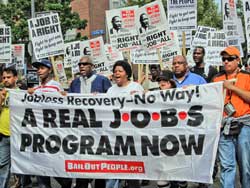
More than 1,000 protesters marched through the streets here on Sept. 20 demanding a real jobs program, like the public works program the Roosevelt administration enacted during the Great Depression of the 1930s.
It was the first demonstration related to the G-20 summit, a gathering of Treasury officials and central bankers from 20 countries that is to take place in the city later in the week. The goal of the G-20 is to protect bank profits. The goal of the March for Jobs is to revive Dr. Martin Luther King Jr.’s call for the right of all to a job. The march was organized by the Bail Out the People Movement and the Rev. Thomas E. Smith, pastor of the Monumental Baptist Church, and endorsed by the United Steelworkers union and the United Electrical Workers.
slideshow photos by LeiLani Dowell, Brenda Sandburg, Dante Strobino and G. Dunkel
The march garnered coverage and interest from major big-business media, both nationally and locally, including the Associated Press, Reuters, the Wall Street Journal, the French Press Agency and others. Organizers of the march attributed the media interest to the fact that the march addressed the crisis of joblessness and its devastating impact on the Black community.
People came from cities throughout the country to join a significant number of Pittsburgh area residents for the march. The cities represented included Los Angeles, San Francisco, Detroit, Cleveland, Akron, Minneapolis, Baltimore, Miami, New York, Buffalo, Philadelphia, Providence, the North Carolina Triangle area and Boston. Many have been laid off or lost their homes to foreclosures. Despite the crisis, people were spirited, drawing strength from being together and from building a movement.
“In honor of Martin Luther King we are continuing what he started in uniting people together in a poor people’s campaign,” the Rev. Tom Smith, pastor of Monumental Baptist Church and one of the organizers of the march, told the rally. “The G-20 is structuring deals to protect the corporations and not the workers. It’s time for the workers to come together and make a difference.”
People gathered in the morning at Monumental Baptist Church located in the historic African-American Hill district of Pittsburgh. A tent city dedicated to the unemployed had been set up next to the church the day before. Many of the protesters will stay at the tent city throughout the week with more people expected to join as the G-20 summit opens.
An opening rally was held before the march stepped off at about 2:30. People marched carrying hundreds of placards with the image of Dr. Martin Luther King Jr. and chanting, “We got the right! We got the right to a job!” The march ended at Freedom Corner, where in 1963 people got on buses to go to the historic civil rights march in Washington, D.C.
Larry Holmes, an organizer of the Bail Out the People Movement, said the government claims a jobless recovery is on the horizon. He emphasized that this is unacceptable. “A jobless recovery is like a dead patient after a successful operation,” he said.
Monica Moorehead of the organization Millions for Mumia recognized the more than two million people in prison who couldn’t be at the demonstration. She introduced a taped message from political prisoner Mumia Abu-Jamal.
At the closing rally, Fred Redmond, United Steelworkers vice president, noted the need for universal health care and affordable education as well as jobs for all. “Enough of our kids are going to school where the rats outnumber the computers,” he said. “We have to assure that every child receives an education to equip them for the 21st century.”
Other speakers at the two rallies included Oscar Hernandez, a participant in the 11-month Stella D’Oro bakery strike in New York City; Clarence Thomas, International Longshore and Warehouse Union Local 10 and Million Worker March Movement; Brenda Stokely and Jennifer Jones, NYC Coalition in Solidarity with Katrina/Rita Survivors; Rob Robinson, Picture the Homeless; Rosemary Williams, Poor Peoples Economic Human Rights Campaign; Mick Kelly, Coalition for a Peoples Bailout; Nellie Bailey, Harlem Tenants Council; John Parker, Bail Out the People Movement organizer in Los Angeles; Sandra Hines, Michigan Moratorium NOW! Coalition to Stop Foreclosures, Evictions and Utility Shutoffs; Rokhee Devastali, Feminist Students United, University of North Carolina-Chapel Hill; civil rights attorney Lynne Stewart; Larry Hales, FIST (Fight Imperialism Stand Together); Larry Adams, People’s Organization for Progress; Pam Africa, International Concerned Family and Friends of Mumia Abu-Jamal; Victor Toro, an immigrant facing deportation and member of the May 1st Coalition for Worker & Immigrant Rights; Berna Ellorin, BAYAN-USA; Father Luis Barrios, Pastors for Peace; Kali Akuno, U.S. Human Rights Network; and Pennsylvania state Sen. Jim Ferlo.
Why people came to Pittsburgh
The march was a powerful draw for people, many of whom traveled long distances to be part of the event. Strikers from TRW Automotive, a seatbelt-making plant in Mexico, had been in Detroit speaking out about their struggle when they heard about the protest in Pittsburgh and joined the bus from Detroit. One member of the TRW group, Israel Mouroig of the Coalition for Justice in the Maquiladoras, said it was necessary to forge alliances at the international level. “Corporations that generate billions of dollars a year produced the crisis in our country,” he said. “There is a lack of jobs because they see the working class as robots, as numbers. We have to appropriate the means of production and be the actors of our own history.”
Several people drove from Los Angeles, including Guy Anthony, who lost his job as an organizer with the Service Employees union in June. Now living in his car, he has traveled around the country writing a blog about his experiences (thedistantdrummer.com). “You can’t talk about joblessness without talking about homelessness,” Anthony said. He met people in Seattle who had set up “a fabulous tent city” on church property. He also stayed with people who set up a homeless community at a roadside stop off of Route 280 south of San Francisco. “You couldn’t want better neighbors,” he said. “Nobody went hungry. It was a beautiful socialist community.” The county recently shut the group down.
A large contingent from the Boston School Bus Drivers union, USW Local 8751, including Gary Murchison, former three-term president of the local, and Frantz Mendes, current president, showed up three days before the march to help organize and build the tent city.
Detroit activists, who organized a hugely successful tent city in June, brought a busload of people to Pittsburgh. “We had to be here,” said Sandra Hines of the Moratorium NOW! Coalition. “We have to mobilize, organize before they take every right we have away from us.” Latonya Lloyd, who was part of the Detroit delegation, recently battled the shut-off of utilities at the Highland Towers apartment building.
Mary Kay Harris came with about 40 other people on a bus from Rhode Island. A member of DARE (Direct Action for Rights and Equality), Harris said that as soon as they heard about the March for Jobs they decided they had to be there. Rhode Island, which has one of the highest unemployment rates in the country, has a tent city of the homeless. “We feel that solidarity is the most important thing,” she said.
Activists in Cleveland also brought a busload of people, including a large contingent from the Poor People’s Economic Human Rights Campaign. And a group of 18 youth came from North Carolina, including Tracy Gill, a member of FIST who said this was the first big protest she had ever been to.
Members of the Minnesota People’s Bailout Coalition also came to the march. Angel Buechner said the organization had fought for legislation last year that would have provided immediate jobs or income and a moratorium on foreclosures and on the state’s five-year limit on receiving welfare. But Gov. Tim Pawlenty defeated the measure. Despite the setback, Buechner is ready to continue the battle.
At the ending rally at Freedom Corner, Holmes announced—to the approval of the crowd—that the next step is to build a national march for jobs in Washington next April to continue Dr. King’s dream.
Anti-G20 activists accuse Pittsburgh police of harassment
(AFP) – 1 day ago
PITTSBURGH, Pennsylvania — Tensions were running high in this former steel town Tuesday as anti-G20 protesters accused the police of using heavy-handed tactics to discourage them from rallying against this week's summit of world leaders.
A handful of activists were arrested overnight Monday, and volunteer medics, who are in Pittsburgh to provide care to any demonstrators who might be injured during anti-G20 protests on Thursday and Friday, complained of "harassment at the space where they are staying in Polish Hill."
"We've had a couple of reports of people being arrested and given citations on the spot and then being released. And Seeds of Peace, which has a bus on which they cook food (for the demonstrators), had one person arrested," a man called Morgan, who works on a legal hotline set up by ResistG20.org, told AFP.
"It seems pretty clear that the harassment is designed to intimidate people out of exercising their First Amendment rights," said Morgan, who asked not to give his last name.
The first amendment of the United States constitution guarantees free speech and the right to peaceably assemble.
Lawyers from the American Civil Liberties Union on Monday filed a lawsuit on behalf of Seeds of Peace and the Three Rivers Climate Convergence (3RCC) group against the Pittsburgh police bureau.
The complaint, which was filed in a Pennsylvania district court, accuses the police department and several individual officers of harassing anti-G20 activists in a bid to discourage them from taking part in protests on Thursday and Friday, when world leaders are due to hold talks in this once rough-and-tumble US steel town.
"City of Pittsburgh police have engaged in a pattern of illegal searches, vehicle seizures, raids and detentions of 'Seeds of Peace' members," the suit said.
According to the lawsuit, in the early hours of Monday "more than 30 Pittsburgh police officers with semi-automatic weapons" raided a private property in the Lawrenceville neighborhood where Seeds of Peace had parked its food preparation bus.
After the activists refused to allow the police to search the bus or the property it was on because they did not have a warrant, four Seeds of Peace members were detained for nearly two hours on loitering charges, the suit said.
The four, who were detained while walking to their lodgings, were subsequently released without charge, the complaint said.
No one was available for comment at the Pittsburgh police bureau.
Protesters have said they plan to air their opposition to "the undemocratic way in which the G20 operates and the decisions the group makes, which affect the more than six billion inhabitants of this planet."
Most of the groups taking part in the protests say they will be staging non-violent demonstrations of their opposition to the G20.
But residents, officials and security forces fear that violent demonstrations such as those seen in 1999 in Seattle -- where protesters and riot police faced off for days, disrupting a meeting of the World Trade Organization -- or at the G8 summit in Genoa, Italy in 2001, will mar this week's Pittsburgh summit.
Mayor Luke Ravenstahl has called in 4,000 highly-trained federal police officers to back up local security forces.
To prepare protesters for the summit, the Pittsburgh G20 Resistance Group is holding a health and safety workshop on Wednesday, at which activists will learn "how to survive 6,000 riot cops and come out swinging."
Activist groups around Pittsburgh have been organizing housing for the thousands of demonstrators from around the world who are expected to stream into the city for the summit.
On the eve of the summit on Wednesday, workers and environmentalist movements will hold a concert, which 10,000 people are expected to attend, Patrick Young, a member of the anarchist Pittsburgh Organizing Group, told AFP.
The following day around 1,000 people are expected to march towards the summit venue in a protest organized by Pittsburgh G20 Resistance Project (PGRP).
"They have not applied for a permit, nor have they pre-emptively been offered one," said Young.
And on Friday, as the summit winds down, protesters have been called to take part in the main anti-G20 event: a mass march on "institutions that pepper the landscape where the G20's worldview manifests... the places that symbolize the kind of world the G20 works to protect and sustain," the PGRP website says.
Sept. 16—As the G-20 Summit prepares to descend upon Pittsburgh, the city has been thrust into the spotlight, and is being highlighted for its “commitment to employing new and green technology to further economic recovery and development.” It has been and is being denoted as the city that got it right, where pollution has been eroded, the rivers cleaned, and the jobs in industry have thoroughly been replaced.
But this is farce. The changes are superficial and the most oppressed workers have not recovered from the loss of steel jobs; this fact is most clearly seen in neighborhoods like the Hill District.
While the dignitaries that represent the G-20 countries are shown a “revitalized” downtown Pittsburgh, they will not see the conditions of neighborhoods that surround downtown.
As far as gatherings go, the starkest contrast in Pittsburgh during the G-20 Summit week will be between the glamour and glitz of the summit, the primped and polished downtown hotels where world leaders and finance ministers will stay, on the one hand, and, on the other, the Hill—about a mile away from the G-20 Summit convention—where those protesting unemployment will be sleeping in a tent city.
Following a march for jobs on Sept. 20, protesters will live on the Hill throughout the week until the end of the G-20 Summit. The Hill is one of the oldest, poorest, most renowned and besieged African-American neighborhoods in the country.
Once known for its nightlife and jazz clubs, today the streets of the Hill—where famed playwright August Wilson was born—have more than a few boarded houses and failed restaurants, small businesses and neighborhood stores. Parts of the Hill look more like the poorest neighborhoods in Port-au-Prince or the Gaza Strip than a U.S. city.
Most young people of working age who live on the Hill are not only unemployed, most have never had a job, and there are fewer and fewer low wage jobs available to them. From as far back as the mid-1950s, real estate interests have been working hard to push the native poor and working-class inhabitants out of the Hill to make way for the more well-to-do. While that process is not over, the rich, right now, are winning the war for control of the Hill.
I was not born in Pittsburgh, but in another part of western Pennsylvania—Erie, Pa.—where the conditions are different but similar. I was born in 1976 and spent my first 15 years there. My parents worked in factories, my mother making ceramics and my father still for GE Transportations, where he is anticipating retiring after 40 long years making locomotives and locomotive parts.
Both of my parents migrated to Erie from southern Mississippi. They were in their late teens, and neither had a high school education. During the period when my parents migrated from the South, there were many thousands more Black people who did the same, fleeing the repressive and racist conditions in the South in hopes of better paying jobs and better social relations.
By the time I became cognitively aware, conditions in western Pennsylvania and eastern Ohio had already begun to change. The well-paying jobs in the factories were beginning to dry up, and working people in what has now become known as the Rust Belt were being cast off from their jobs in the tens of thousands as deindustrialization set in, sweeping the land like a foreboding cloud of doom.
I can recall the looks on the faces of children I attended school with. Their parents would lose their jobs, and though as children we could not completely comprehend the consequences of our parents’ unemployment, the despair on their faces was enough. It’s like a child who falls but looks around for the reaction of the adults before deciding whether to laugh or cry.
I was not aware then—few of the children of factories workers really were—of what was happening in Pittsburgh, the shuttering of steel plants because of technology or outsourcing. Pittsburgh is much larger than Erie, and has a richer history of struggle, but is also a city that had long been under the sway of the Mellons, Carnegies and other super-rich who made their fortunes off of the exploitation of working people, even hiring armed thugs like the Pinkertons to shoot down striking workers.
Pittsburgh, like Erie and most U.S. Midwest cities where 20 percent of the population is Black, is largely segregated. But at least Black people had the Hill. Back in the day, the Hill was the place that Black steelworkers could make a better life for their families than their parents could make for them. The hope of those on the Hill who are trying to hold on to all they have is that the jobs march and tent city will help them even the odds a little against the gentry.
People from as far away as North Carolina, New York, Miami, Detroit, Minneapolis and even California will be meeting on the Hill in front of Monumental Baptist Church at Wylie and Soho Streets at 2 p.m., Sunday, Sept. 20, for the march for jobs. The marchers, who are expected to be in the thousands, will march to Freedom Corner at Crawford and Centre Streets where there is a monument to civil rights activists and leaders.
After Black residents were pushed out of what was once called the lower Hill to make way for the development of a stadium, Freedom Corner is where the Black community rose up and proclaimed that the developers would not be able to push beyond that point. Freedom Corner is where thousands gathered in the summer of 1963 to board buses to travel to the historic civil rights march in Washington, D.C. It is also where angry and shocked people gathered on that terrible day in April 1968 when Martin Luther King Jr. was assassinated.
There could not be a more appropriate location in Pittsburgh for the jobs march to rally because it was Dr. King’s vision of a second civil rights movement, a movement for the right of all to decent paying jobs, that the civil rights leader dedicated the final weeks of his life to. The goal of the jobs march is to revive that vision. After the rally, many will return to Monumental Baptist Church, the site of the Bail Out the Unemployed Tent City, to get ready for their first night underneath the sky.
Hales is a native of Erie, Pa., a leader of FIST (Fight Imperialism, Stand Together), and a regular contributor to Workers World. Posted just before the G-20 demonstrations, Hales’ commentary can be found on Real Talk Xpress, the International Action Center, fistyouth.wordpress.com and other sites and blogs.